
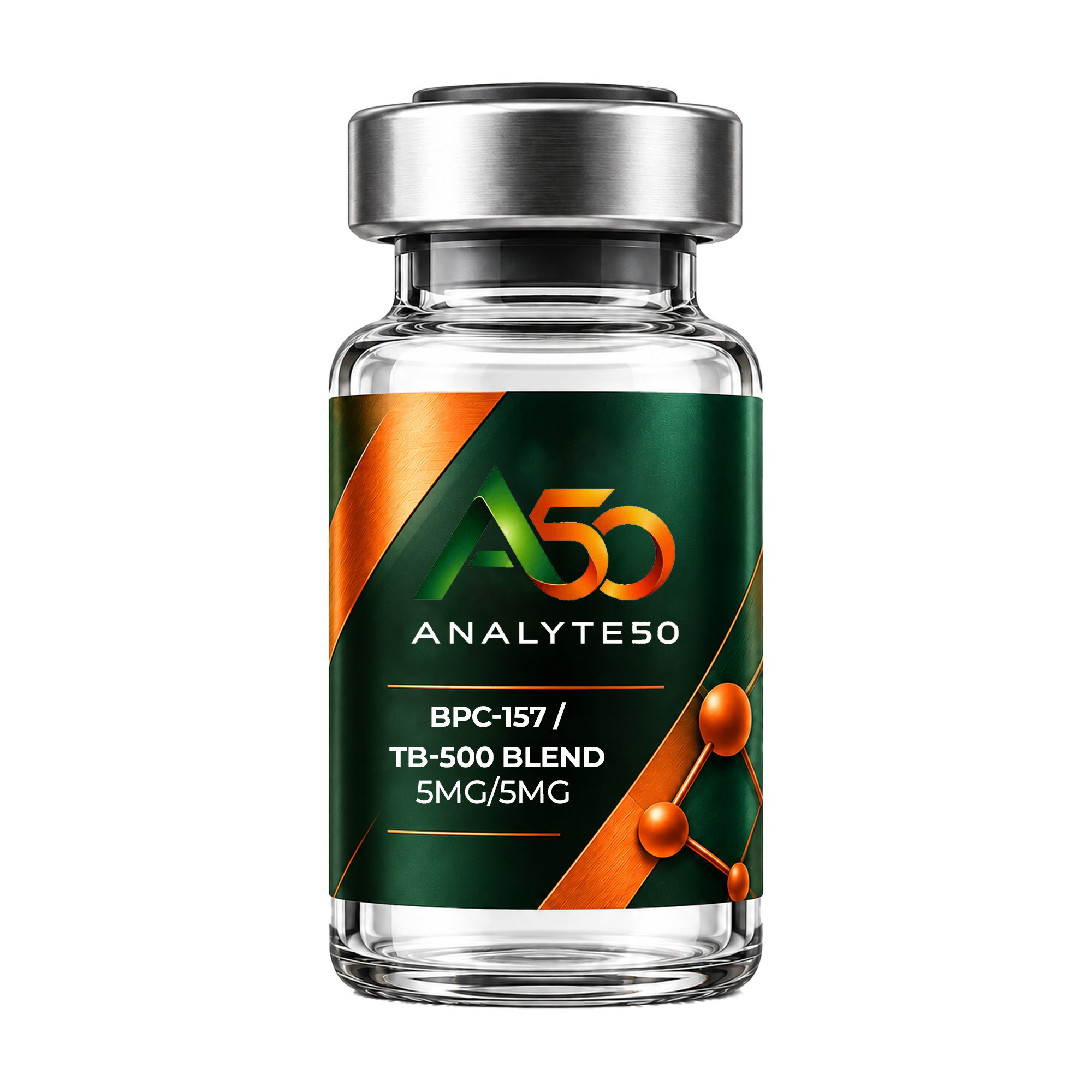
Description
Product Specifications
Form: Lyophilized dual-peptide powder
Strength: Add the product-specific BPC-157 / TB-500 strength
Compound Classification: Dual synthetic peptide research formulation
Components: BPC-157 and TB-500
Combined Molecular Formula: Not applicable as a single value because the blend contains two independent peptide molecules
Combined Molecular Weight: Not applicable as a single value
Blend CAS Number: No single CAS number applies to the complete formulation
BPC-157 Component
Peptide Length: 15 amino acid residues
Peptide Classification: Synthetic linear pentadecapeptide research compound
Peptide Sequence: Gly-Glu-Pro-Pro-Pro-Gly-Lys-Pro-Ala-Asp-Asp-Ala-Gly-Leu-Val
One-Letter Sequence: GEPPPGKPADDAGLV
N-Terminal Modification: None
C-Terminal Modification: Free carboxyl terminus
Molecular Formula: C₆₂H₉₈N₁₆O₂₂
Molecular Weight: Approximately 1419.5 g/mol
CAS Number: 137525-51-0
PubChem confirms the BPC-157 sequence, formula, molecular weight, and CAS information above.
TB-500 Component
Peptide Length: 7 amino acid residues
Peptide Classification: Synthetic N-terminally acetylated thymosin beta-4-derived peptide fragment
Peptide Sequence: Ac-Leu-Lys-Lys-Thr-Glu-Thr-Gln-OH
One-Letter Sequence: Ac-LKKTETQ-OH
N-Terminal Modification: Acetylated
C-Terminal Modification: Free carboxyl terminus
Molecular Formula: C₃₈H₆₈N₁₀O₁₄ for the commonly referenced Ac-LKKTETQ form
Molecular Weight: Approximately 889.0 g/mol
CAS Number: 885340-08-9, where assigned to the Ac-LKKTETQ TB-500 fragment
Cayman Chemical identifies TB-500 acetate as Ac-LKKTETQ-OH with molecular formula C₃₈H₆₈N₁₀O₁₄ and molecular weight approximately 889.0, while WADA documentation identifies TB-500 as N-Ac-LKKTETQ.
Blend Specifications
Purity: Individual peptide purity should be ≥99%, where confirmed through batch-specific HPLC analysis
Appearance: White to off-white lyophilized peptide powder
Intended Use: Laboratory research and analytical applications only
Research Applications
Analytical characterization using HPLC, UPLC, and LC-MS workflows
Simultaneous identification of BPC-157 and TB-500 within a multi-peptide formulation
Chromatographic separation and quantification of individual blend components
Comparative analysis of linear and N-terminally acetylated peptide structures
Structure-activity assessment of distinct peptide sequences
Investigation of peptide-mediated molecular interactions under controlled conditions
Evaluation of component identity, purity, molecular weight, and structural integrity
Assessment of formulation homogeneity and batch-to-batch consistency
Evaluation of component compatibility within a dual-peptide formulation
Stability profiling under defined temperature, pH, buffer, and storage conditions
Quality Documentation
A batch-specific Certificate of Analysis and applicable analytical documentation should be available for each lot. Documentation should independently verify the identity, amount, and purity of both BPC-157 and TB-500 together with formulation ratio, molecular mass, counterion status, and batch information.
Particular attention should be given to the identity assigned to TB-500. The designation has not been used consistently across all commercial and scientific contexts. WADA analytical documentation specifically identifies TB-500 as N-acetyl-LKKTETQ, while some commercial materials may use the name for other thymosin beta-4-related preparations.
A single molecular formula, molecular weight, or CAS number should therefore not be assigned to the complete BPC-157 / TB-500 blend. Batch-specific HPLC and mass-spectrometric documentation should be used as the final reference for component identity and analytical specifications.
For Laboratory Research Use Only
This product is intended exclusively for controlled laboratory and in vitro research. Not for human or veterinary use. Not for diagnostic, therapeutic, clinical, cosmetic, or household applications.
Reviews
There are no reviews yet.