
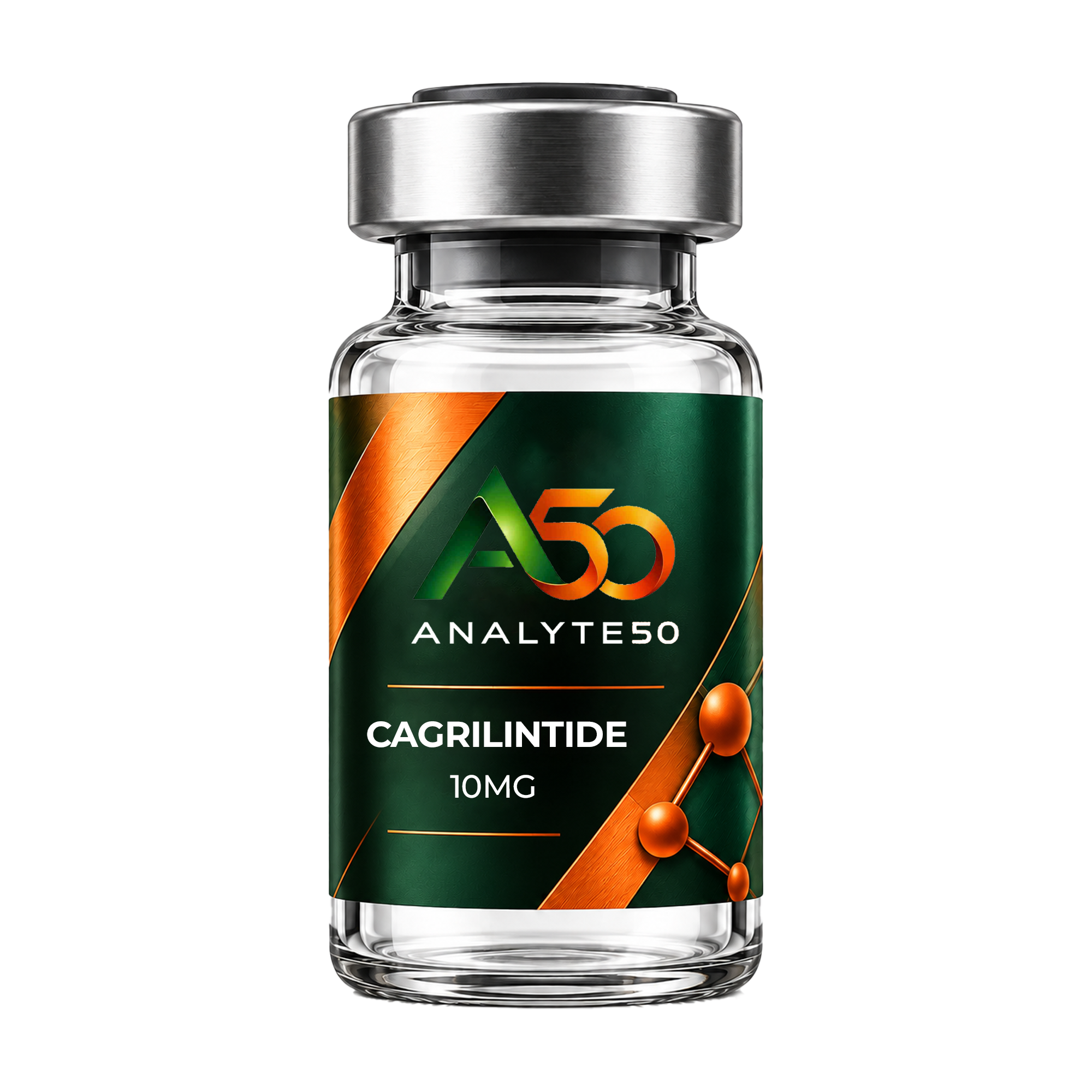
Description
Product Specifications
Form: Lyophilized peptide powder
Strength: Add the product-specific strength
Modified Chain Length: 38 amino acid residues when the N-terminal γ-Glu linker residue is included
Amylin-Derived Peptide Portion: 37 amino acid residues
Peptide Classification: Synthetic lipidated long-acting amylin analog research peptide
Modified Peptide Sequence: (Eicosanedioic acid-γ-Glu)-Lys-Cys-Asn-Thr-Ala-Thr-Cys-Ala-Thr-Gln-Arg-Leu-Ala-Glu-Phe-Leu-Arg-His-Ser-Ser-Asn-Asn-Phe-Gly-Pro-Ile-Leu-Pro-Pro-Thr-Asn-Val-Gly-Ser-Asn-Thr-Pro-NH₂
Short Sequence: (Eicosanedioic acid-γ-Glu)-KCNTATCATQRLAEFLRHSSNNFGPILPPTNVGSNTP-NH₂
Structural Modification: Intramolecular disulfide bridge between Cys³ and Cys⁸ when the N-terminal γ-Glu residue is included in residue numbering
Equivalent Amylin-Backbone Numbering: Cys²-Cys⁷ disulfide bridge within the 37-residue peptide portion
Lipid Modification: N-terminal γ-glutamyl linker acylated with eicosanedioic acid
C-Terminal Modification: Amidated
Molecular Formula: C₁₉₄H₃₁₂N₅₄O₅₉S₂ for the defined parent structure
Molecular Weight: Approximately 4409.0 g/mol
CAS Number: 1415456-99-3
Purity: ≥99%, where confirmed through batch-specific HPLC analysis
Appearance: White to off-white peptide powder
Intended Use: Laboratory research and analytical applications only
Research Applications
Analytical characterization using HPLC, UPLC, and LC-MS workflows
In vitro investigation of amylin receptor-binding behavior
Evaluation of interactions involving AMY₁R, AMY₂R, AMY₃R, and calcitonin receptor systems
Investigation of receptor-associated intracellular signaling under controlled assay conditions
Structure-activity analysis of modified amylin analogs
Characterization of lipidated peptide architecture and side-chain modifications
Evaluation of disulfide-bond integrity using suitable analytical techniques
Peptide identity, purity, molecular weight, and structural integrity analysis
Comparative assessment of Cagrilintide and related amylin-derived research peptides
Stability profiling under controlled temperature, pH, buffer, and storage conditions
Quality Documentation
A batch-specific Certificate of Analysis and applicable analytical documentation should be available for each lot. Verify peptide identity, exact modified sequence, disulfide configuration, N-terminal lipid modification, C-terminal amidation, purity, molecular weight, counterion content, formulation details, and batch information against the records supplied with the individual product.
Cagrilintide is a structurally modified peptide and should not be represented solely by its unmodified amino acid backbone. The defined molecular identity includes the N-terminal eicosanedioic acid-γ-Glu modification, disulfide bridge, and C-terminal amide.
Acetate-containing Cagrilintide preparations may be reported as C₁₉₄H₃₁₂N₅₄O₅₉S₂·xC₂H₄O₂, with variable acetate content. Cayman Chemical lists Cagrilintide acetate using this variable-counterion representation while reporting 4409.1 as the parent peptide formula weight. Batch-specific HPLC and mass-spectrometric documentation should therefore be used as the final reference for analytical specifications.
For Laboratory Research Use Only
This product is intended exclusively for controlled laboratory and in vitro research. Not for human or veterinary use. Not for diagnostic, therapeutic, clinical, cosmetic, or household applications.
Reviews
There are no reviews yet.